Naples/Pompeii
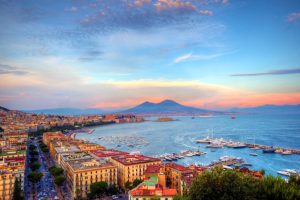
The main city square or piazza of the city in Naples is the Piazza del Plebiscito. Its construction was begun by the Bonapartist king Joachim Murat and finished by the Bourbon king Ferdinand IV. The piazza bounded on the east by the Royal Palace and on the west by the church of San Francesco di Paola, with the colonnades extending on both sides. Nearby is the Teatro di San Carlo, which is the oldest opera house in Italy. Directly across from San Carlo is Galleria Umberto, a shopping centre and social hub.
Naples is well known for its historic castles: the ancient Castel Nuovo, also known as Maschio Angioino, is one of the city’s foremost landmarks; it was built during the time of Charles I, the first king of Naples. Castel Nuovo has seen many notable historical events: for example, in 1294, Pope Celestine V resigned as pope in a hall of the castle, and following this Pope Boniface VIII was elected pope by the cardinal collegium, before moving to Rome. The castle which Nuovo replaced in importance was the Norman-founded Castel dell’Ovo (“Egg Castle”), which was built on the tiny islet of Megarides, where the original Cumaean colonists had founded the city.
Another Neapolitan castle of note is Sant’Elmo, which was completed in 1329 and is built in the shape of a star. During the uprising of Masaniello in 1647, the Spanish took refuge in Sant’Elmo to escape the revolutionaries. The Vigliena Fort, which was built in 1702, was destroyed in 1799 during the royalist war against the Parthenopean Republic, and is now abandoned and in ruin. The Carmine Castle, built in 1392 and highly modified in the 16th century by the Spanish, was demolished in 1906 to make room for the Via Marina, although two of the castle’s towers remain as a monument.
| Languages spoken | Italian |
|---|---|
| Currency used | Euro |
| Country name | Italy |